
Compliance as a Value Enabler: PowerSync listed for CSIP-AUS v1.2
Blog
>
Energy
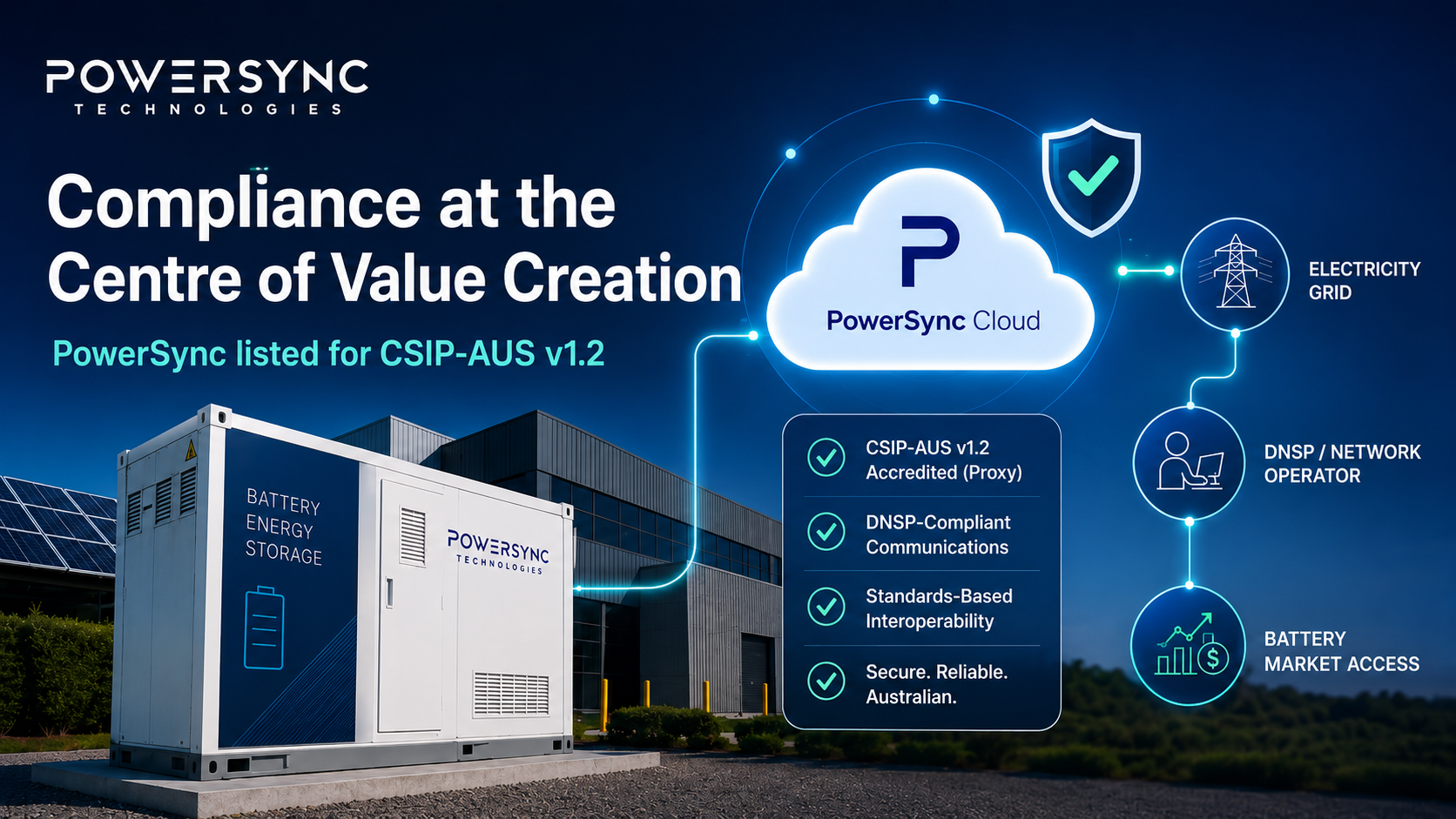
PowerSync’s listing on the Clean Energy Council’s CSIP-AUS v1.2 register is an important milestone because it demonstrates that PowerSync’s platform is aligned with the communications standards energy grids are increasingly requiring for distributed energy resources.
A battery only creates value if it can be connected, controlled and operated in a way that allows energy to flow into the market and respond to network requirements. If the technology pathway is not compliant with grid (DNSP) requirements, the battery may not be able to access the full value available from wholesale energy, FCAS, dynamic exports or other market participation opportunities.
Compliance is the gateway to market value
Compliance is an important gateway to value. If a battery cannot comply with DNSP requirements, it may not be able to operate in the way needed to access energy market revenues. In practical terms, that means a customer could invest in a battery but still face limitations on how that battery is used, how it exports, how it responds to network constraints, or how it participates in broader energy market opportunities.
This is why thep athway between the site, the DNSP and the energy market matters. To unlock value from a battery, customers need more than optimisation. They need a compliant route to participation.
PowerSync takes care of the pathway
PowerSync takes care of this pathway through its full-stack solution. Our platform has been built across the DER value chain, from site integration and communications through to orchestration, market participation, compliance, reporting and settlement.
This means customers do not need to manage separate technology providers, custom integrations or fragmented compliance processes to monetise their battery or flexible energy asset. PowerSync has invested heavily in the infrastructure required to integrate DER smoothly, efficiently and compliantly.
Why DNSP compliance matters
DNSPs are moving toward more active management of distributed energy resources. Across Australia, standards-based communication pathways are increasingly being used for dynamic connections, flexible exports, emergency backstop functions and broader DER coordination.
This is already visible across a number of grids. In Queensland, Energex and Ergon Energy Network are offering dynamic connections and flexible exports as an alternative to fixed export limits. In South Australia, SA Power Networks has implemented dynamic export requirements for new and upgraded exporting systems. In Victoria, the emergency backstop framework applies across the Victorian DNSPs, including AusNet, CitiPower, Powercor, United Energy and Jemena. These examples show that DNSP requirements are moving from static connection approvals toward real-time visibility, communication and control.
This is where CSIP-AUS becomes important. Without a compliant CSIP-AUS pathway, a battery may be unable to operate effectively. DNSPs increasingly need to send and receive operating instructions, export limits and control signals in real time. If the battery, inverter or orchestration platform cannot communicate through the required standard, the asset may be restricted to static export limits, prevented from accessing flexible export arrangements, or unable to respond to emergency backstop or dynamic operating envelope requirements.
In practical terms, this can limit how much energy the battery can export, when it can operate, and whether it can participate in the value streams that depend on network visibility and control. A battery may still be physically installed, but without compliant communications it may not be able to access its full commercial value.
What the CEC listing demonstrates
PowerSync’s listing asa Proxy (Aggregator) software client on the CEC CSIP-AUS v1.2 register demonstrates PowerSync’s investment in compliance and full-stack DER integration.
It shows that PowerSync has built the technical capability required to support compliant DER communications with DNSPs, while also enabling assets to participate in energy markets. It provides customers, partners and DNSPs with confidence that PowerSync’s platform is aligned with the communications framework now being adopted across the market.
PowerSync’s listing also reflects the role we play in the DER value chain through providing the compliant pathway that allows batteries, flexible loads and other DER to be integrated, orchestrated and monetised in the first place.
Built for the next phase of DER participation
Without that pathway, the battery cannot reliably access its full value. If it cannot communicate with DNSPs in the way required, it may be limited in how it exports, responds and participates in the energy market.
PowerSync’s CSIP-AUSv1.2 listing demonstrates that our platform is built to provide that pathway - smoothly, efficiently and compliantly. It shows that PowerSync has invested across the value chain to make DER integration easier for customers, more reliable for partners and more aligned with where the grid is going next.
Share this post
- Blog
Latest Insights and Trends
Explore the latest trends in energy technology and solutions.
.jpg)


- Level 2, 275 Alfred Street, North Sydney, NSW 2060
- 1300 101 429
- info@powersync.com.au