
AEMO’s 2026 ISP points to a larger role for battery and load flexibility
Blog
>
Energy
AEMO’s final 2026Integrated System Plan gives a useful signal about where the National Electricity Market is heading.
The headline pathway remains familiar with renewable energy, connected by transmission and distribution, firmed with storage and backed by flexible gas, remaining as AEMO’s least-cost pathway for the NEM through to 2050.
The more relevant signal for PowerSync is how much of that pathway depends on flexibility.
AEMO is planning for a system with almost 120 GW of utility-scale wind and solar by 2050, almost 50 GW of utility-scale storage and hydro, 17 GW of flexible gas-powered generation, and a much larger role for consumer energy resources. Renewables are expected to rise from around 45% of NEM energy in 2025 to 82% by 2030 and 98% by 2050.
That is a very different operating environment from the system the NEM was built around.
Coal remains a large part of the market today, but nearly 40% of the original coal fleet has already retired. Under the 2026 ISP, most of the remaining coal fleet is projected to withdraw by 2038, with all remaining coal withdrawn by 2049.
As thermal capacity exits, the market will rely more heavily on batteries, flexible gas, demand response and coordinated consumer resources to manage price volatility, reliability and daily supply-demand balance.
A practical way to think about volatility
PowerSync has been using a simple internal Volatility Index to frame this transition.
The index is not intended to be a revenue forecast. It is a directional way to think about the relationship between volatility drivers and flexibility providers.
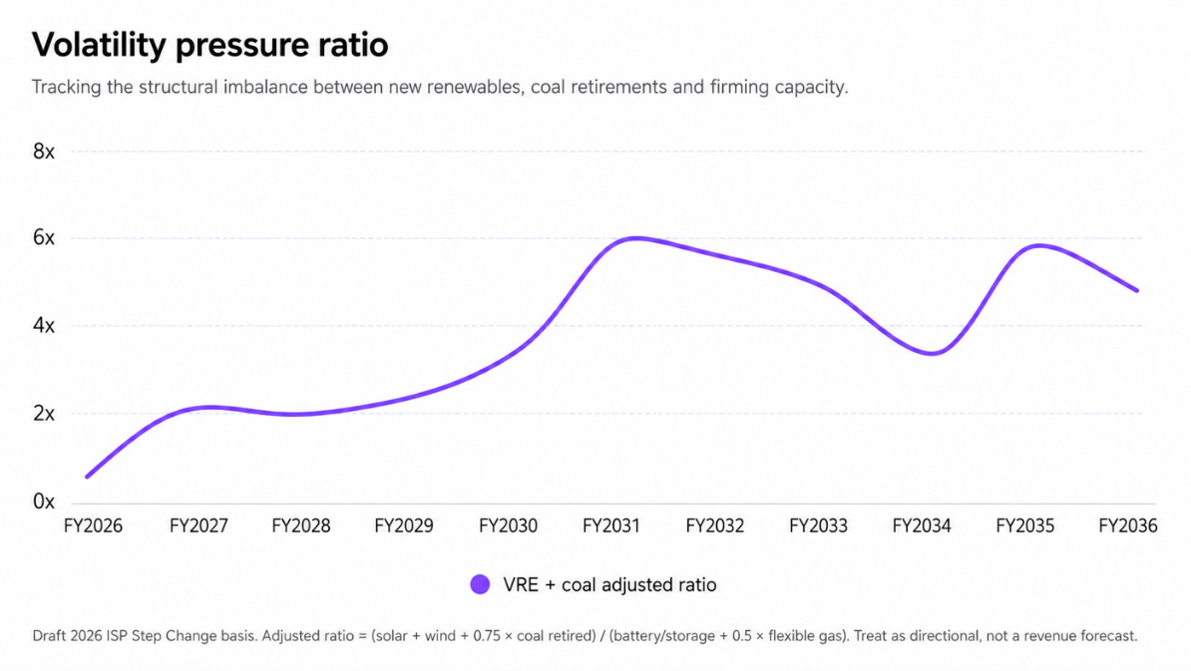
The version prepared for our earlier analysis used the following adjusted ratio: Adjusted ratio =solar + wind + 0.75 x coal retired / battery storage + 0.5 x flexible gas
The purpose of the adjustment is to avoid treating every megawatt in the same way. New variable renewable energy increases the need to shift and firm energy across time. Coal withdrawals remove dispatchable capacity that has historically helped meet evening, overnight and low-renewable periods. Batteries and flexible gas reduce the pressure, but they perform different roles and do not neutralise volatility in the same way.
The chart shows a structural pressure that is likely to remain visible through the transition. Inperiods where renewable build and thermal withdrawal move faster than firmingcapacity, volatility pressure rises. In periods where batteries and other flexibleresources scale faster, that pressure moderates.
This is useful framing for asset owners and large energy users. The ISP describes a very large build task, but it also describes a much more complex operating task. As the system becomes more weather-dependent and less thermally backed, flexible assets need to be visible, controllable and market-connected.
Batteries are becoming core market infrastructure
The 2026 ISP reinforces the growing role of batteries in the NEM. AEMO projects that 35 GW of shallow and medium storage will be needed by 2050 for intra-day firming, with around 33 GW required by 2030. That is the role most relevant tobatteries: charge when renewable energy is abundant, then discharge into evening and morning peaks.
Battery developmenthas accelerated materially. AEMO notes that the new storage connections pipeline has increased from 3 GW in September 2022, to 17 GW in 2024, and to 45GW in 2026. Around 70% of the batteries in that connections pipeline arecoupled with grid-forming inverters, which means they can contribute not onlyenergy shifting, but also system security services such as FCAS and system strength support.
Recent market data shows how quickly battery activity is changing. In Q1 2026, AEMO reported that average NEM battery discharge increased to 359 MW, compared with 98 MW in Q12025. Batteries also more than tripled their daytime-to-evening energy shifting, delivering 1,115 MW into the evening peak. AEMO attributed this shift to 4,445MW of new battery capacity added over the previous 12 months, more than doubling total installed battery capacity.
That scale-up matters for battery owners - as more batteries enter the market, the opportunity becomes more dependent on operating quality. Wholesale arbitrage, FCAS, negative-price charging, state-of-charge management, degradation, network constraints and site load all need to be managed together.
A market facing battery can no longer create value with simple controls and meet compliance requirements. A battery with sophisticated orchestration can make better decisions about when to charge, when to discharge, when to preserve capacity, when to chase volatility and when to support site requirements – all the while remaining market compliant.
Load flexibility is becoming part of the market design
The final 2026 ISP also gives more weight to the demand side.
AEMO’s planning now explicitly considers consumer energy resources, distribution networks and demand-side factors. This is relevant because the NEM’s flexibility need will not be met by grid-scale batteries alone.
Commercial and industrial customers already have flexible capability across batteries, refrigeration, pumping, water treatment, thermal processes, EV charging, backup systems, embedded generation and controllable site load. Much of that flexibility is currently underused because it is not measured, forecast, controlled or connected into market processes.
Wholesale Demand Response is one of the clearest examples of this shift. Under WDR, a Demand Response Service Provider can classify and aggregate the demand response capability of large market loads and bid that capability through the NEM’s standard dispatch processes. The response is measured against an approved baseline and dispatched through the wholesale market.
That mechanism matters because it gives eligible load a market pathway. A demand reduction can act as a substitute for generation in high-price or tight supply periods.
The AEMC’s 2025 review recommended that WDR continue operating and noted that it remains the only NEM wholesale market mechanism that facilitates payment for reducing load against a baseline. It also recommended that the rule change process to expand WDR eligibility be initiated.
That is relevant for large C&I sites, particularly those with multiple connection points or complex operating profiles. More flexible load exists in the market than is currently visible to dispatch. Unlocking that flexibility requires both regulatory pathways and the control systems to participate reliably.
The opportunity for C&I customers
For C&I customers, the 2026 ISP raises a practical question - How much of the site’s demand is flexible?
The answer is rarely clear from the energy bill. It depends on the site’s equipment, operating windows, production constraints, metering, control systems and risk tolerance.
A flexible site can reduce exposure to volatile intervals. It can shift consumption into periods of high renewable output. It can support WDR or other demand response programs. Where a battery is installed, it can combine site optimisation with wholesale and FCAS participation.
The value comes from choosing the right action at the right time.
A battery may be best used for solar soak in one interval, FCAS enablement in the next, peak demand management later in the day, and wholesale discharge in the evening. A flexible load may be best shifted into the middle of the day when solar is abundant, or reduced during scarcity events when the system is under stress.
This is where orchestration becomes a commercial capability. It links the physical behaviour of the site to the market conditions around it.
Why the Volatility Index matters
The PowerSync Volatility Index helps explain why this matters.
The numerator captures pressure: more solar, more wind and more thermal withdrawal. The denominator captures response: more battery storage and more flexible gas.
When the numerator grows faster than the denominator, the system becomes more exposed to price separation, scarcity intervals, curtailment, negative pricing, ramping requirements and volatile evening peaks. When the denominator grows faster, more of that volatility can be absorbed or reshaped.
The final 2026 ISP suggests both effects will be present. On one side, the NEM needs almost 120 GW of utility-scale wind and solar by 2050, with renewables reaching 82% by 2030.On the other side, AEMO now sees a much larger battery pipeline and a materially larger role for consumer storage, coordinated CER and flexible demand.
As more batteries connect, simple participation strategies will face more competition. As renewable penetration rises, the quality of forecasting, dispatch and state-of-charge management becomes more important. As large loads grow, particularly from electrification and data centres, flexible demand becomes more valuable.
For PowerSync, this supports a simple market view: the NEM will need more orchestrated flexibility, across both batteries and load.
The next phase is coordinated participation
The 2026 ISP is along-term planning document, but many of the relevant changes are already visible.
In Q1 2026, renewables supplied 46.5% of NEM generation, the highest share on record for a first quarter. Underlying electricity demand reached a record 25,496 MW, up 1.2% on the same period last year, although record rooftop solar output offset much of that growth at the operational demand level.
Grid-scale solar generation averaged 2,706 MW in the quarter, up 13% year-on-year. Wind generation averaged 3,845 MW. Batteries also played a more active operational role, including stronger daytime charging and evening discharge.
Data centres are also emerging as a material planning issue. In Q1 2026, AEMO reported 11 large-scale data centre projects above 5 MW progressing through the transmission connection process, representing 5.4 GW of maximum demand. Around 60% of that capacity was in New South Wales and 40% in Victoria.
This points to a market where value will increasingly depend on coordination.
More batteries will need to operate across multiple value streams. More load will need to become flexible. More consumer assets will need to be coordinated through VPPs andmarket-facing platforms. More C&I customers will need software that cant urn volatility into practical dispatch decisions.
That is the role of orchestration.
Contact Power Sync Technologies to review your site or portfolio and identify where orchestration can reduce exposure, improve market participation and create new revenue.
Share this post
- Blog
Latest Insights and Trends
Explore the latest trends in energy technology and solutions.
.jpg)


- Level 2, 275 Alfred Street, North Sydney, NSW 2060
- 1300 101 429
- info@powersync.com.au